

Alright, my fellow basement dwellers, we have our first but not last interview for MER. I had the privilege of speaking with THE band in South African Black Metal. Even if you know nothing about South Africa (shame on you!), you know that Wildernessking (Wilderness and king, do you get it?) is the most important Black/Post Metal band coming from the deep south (Not Alabama, you American-centered people!). Destiny crossed my path with Keenan because I was the first person to get a digital copy of The Writing of Gods in the Sand. Exploiting my special status, I managed to convince Keenan to open this section for us. Needless to say, Keenan is an awesome and fun guy that I can’t wait to have a beer with. But putting my fanaticism aside, I did try to keep it together and ask him questions like his influences, which are close to what you’d expect.
Keenan: So, I guess we listen to a lot of the Norwegian bands from the 90s, the typical stuff like Darkthrone and Immortal. But I think I was really excited about the new wave of American Black Metal that was booming at that time (around 2009/2010), like Wolves in the Throne Room.
We proceeded to dive into our love for old WITTR, which you should too, by the way. However, I had a main question for this interview, and it was to learn about the South African scene. You see, I love to cover Europe and North America, but I’m sick of it sometimes. This whole section is to make unknown voices shine! To my dismay, Keenan confirmed my fears and told me that although the scene had its moments, it’s become fragmented and more underground than before. However, nothing could compare to the true dark times of Metal in South Africa: the Apartheid times…
Keenan: There was a time in the 90s when we were getting a bunch of bands, and then in the 00s again. This guy, Shaughn, ran a label called Witchdoctor Records and a festival called Witchfest. He was responsible for bringing a lot of international bands from America and Europe, even beyond those continents, to SA. I think there was more of a scene then in the 90/00s. Napalm Death and Carcass came, a bunch of bands… But we were still living under the Apartheid regime. You forget about all the racial stuff and segregation that happened, but obviously, Metal was definitely not allowed in this country…There’s this organization called Metal4Africa. They do a show called Summerfest and Winterfest to showcase all the local and national Metal bands, both up-and-coming and well-known, mostly in Cape Town. Those shows are really well attended, but other than that, it’s pretty dead at the moment.
Of course, it’s not total death, but according to Keenan, you’ll have to see strange line-ups that aren’t too Metal. Think about it from your cozy sofa or computer—there were and still are places where people risk their lives to produce the music we love. I had no idea (and I should have) that Apartheid would hate Metal, but it’s obvious now. So to all those Metalheads longing for an authoritarian regime that puts people in boxes, your artistic freedoms are the first to get the axe. Speaking about boxes, it was time to ask another uncomfortable question: Which box does Wildernessking fit into? Post, Black, or both? He made it easy and just agreed with all of them.
Keenan: Yeah and coupled with all the other bands that we love, like Opeth, Neurosis, and Mastodon, we were taking all that roughly Metal stuff. Enslaved was a big influence, obviously. I guess we were writing things that we were excited about, and that included non-Metal influences too. But I would agree with you in saying that we were a type of Black Metal.
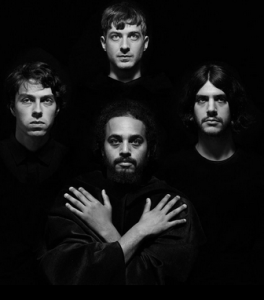
I was starting to wonder if the reason Wildernessking split up was because of financial reasons, since Keenan mentioned how dead the scene was in the country. It seemed like a good hypothesis. I also mentioned that all the information I get from SA is rather negative, so of course, I wanted to hear his version, which was pleasantly surprising. Also, if you ever wonder if you make a difference for underground bands, let me tell you that you absolutely do, and hearing that from the artist was the most assuring thing I’ve heard in a long time. So just like any social movement, your contribution does matter!
Keenan: I mean, to be honest, we just had our elections now, and that’s always a crazy time. But if there’s anything I can say about the status of SA now, I would weirdly say that it’s in the best place it’s ever been. Our tourism industry is going crazy, man. I know that we had a bad rep over the years because of our previous government, but things have changed quite a lot. I work in a bar in the city center of Cape Town… This past summer I think we’ve had the biggest influx of tourists since we opened nearly 10 years ago… Our band had support before streaming services were a big thing. We were making our money through Bandcamp, and we had this incredible support system. People like you from all over the world were reaching out and buying records. Because of that amazing Metal underground, we had a real network of support.
If it wasn’t the money or the lack of support, what was it? I dislike asking bands how things ended—it’s almost like asking people why they broke up with their ex—so I decided to ask the question differently. I asked Keenan if he missed Wildernessking. Little did I know, I’d get a bittersweet answer.
Keenan: To be honest, the way the band kind of ended was really sad, man. I really didn’t want it to. It was my baby, something I wanted to do with my life forever. We had so many weird personal stuff, and we weren’t able to communicate with each other. For me, at least, we did a European tour in 2017 with one of the original members missing because we had a bit of a fallout. Things were strange, but I wanted to take the band and really pursue it, whereas most of the other guys, or at least half of them, only wanted to do it in more of a fun capacity, which I just never understood. I don’t know what they were scared of. But hey, you can’t force anyone’s hand.
However, it’s not all doom and gloom! I’m happy to say that Keenan has another project going that is alive and well. It might even bring some solace to those like me who miss Wildernessking. Its name is Constellatia, and I could do all the ruthless promotion of the band here, but why not hear it from the man himself?
Keenan: For me, it kind of sounds like where Wildernessking left off. I think it’s maybe a bit more spacey and flowy than Wildernessking. It doesn’t have as many riffs… it’s more ethereal and on the Cult of Luna meets Pink Floyd side of things.
I was so delighted to even hear something could sound like a mix of Wildernessking and Cult of Luna, so I speak for everyone when I say we should totally give Constellatia a go. If you’re in Central Europe, maybe you’ll get lucky and see them live since Keenan is moving to Berlin soon to pursue this project in more depth. I was excited just hearing all this, so I had to keep it together and ask my last few questions. I wanted to know more about the breathtaking art of their albums.
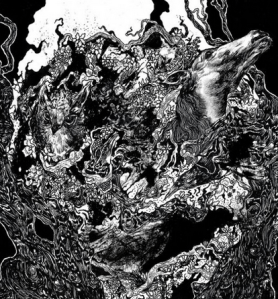
Keenan: Thanks, man. You know what, it’s so crazy. The artist Reuben Sawyer did the cover artwork for Deafheaven‘s first record Roads to Judah. I always loved that record so much. It was quite an influence on me, not so much on our band, but I remember personally just really loving that first offering. I care so much about concepts and words. I loved the title and the way it looked, and reading through the lyrics was very esoteric and bizarre. You didn’t really know what they were saying, but it had a poetry to it, which I loved. It really pulled me in. So yeah, that was a big influence on me in my own personal music journey. I loved the artwork and reached out to Reuben. He was doing a lot of work for some American underground bands around 2010-2011. I threw some concepts at him, and that was it.
That was for the first album, but I also wanted to mention Mystical Future, since many of you distracted people don’t notice because we’re all sick of mountains in Black Metal. But this one was different, and the sky was different too. I was wondering if Keenan was trying to give his own interpretation to such a Nordic-dominated genre, and obviously, he supported my theory (finally, the snobbery pays off).
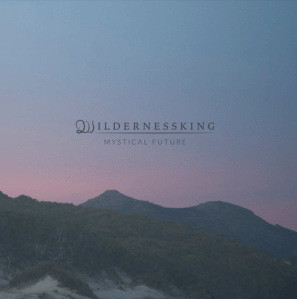
Keenan: Absolutely. Exactly, man. I love that you said that. We still play Black Metal, and we love this genre so much. We never want to be separated from it, you know. So that was our homage to the genre. We can have mountains as well, but it’s gonna be our mountains. We have all this beautiful scenery. We wanted to show the world what’s going on in the southern hemisphere. They’re located in the deep south of Cape Town. My girlfriend at the time lived in that part of the city, so I would drive by those mountains, and we would be by the ocean. It was beautiful.
Amazing, right? I also had more boring questions that many of you will hate. Yes! I’m talking about production, specifically how Mystical Future sounded so clean and its acoustics so cool, as if it was recorded in a cathedral. The answer wasn’t straightforward, but still fascinating! It links the band so much with Deafheaven and the whole Post/Black Metal scene of the 2010s.
Keenan: The record was mixed by Jack Shirley, who mixed the first couple of Deafheaven records (and more since). The second record Sunbather shook the Metal world, the whole music world… In Wildernessking, we were very active at that point. We had our debut out and were working on Mystical Future. A part of me was so happy for them. I used to see them as our peer band. We were both growing in this moment, but a part of me was kind of jealous! (We both laughed here!), because I wanted to do what they were doing. But it’s been so amazing, because George, the singer of the band… I sent him our first record. He just said thanks at the time, but years later, with me in my new band, it was one of the most amazing and validating things that have ever happened to me as a musician so far. He didn’t know that I was involved, but sent Constellatia a message on our Instagram saying how big of a fan he was and how excited he was for our second record. That was a beautiful full-circle moment.
It was so touching to see how despite all the ups and downs, Keenan still found meaning in making the music we all love and that his resolve to keep moving forward was not only intact but also renewed by such validating experiences. Our time was running out, so I let Keenan say a few words to all of us basement-dwellers.
Keenan: I’m so honored to be part of this amazing community. That’s why I’m so excited about moving to Europe because I want to be more involved in it. I love Cape Town so much. I’ve been here my whole life, but in terms of Metal and a thriving scene, it’s very difficult. I don’t know that many people outside of my band anymore that listens to Metal (at least in my close circles), and it’s sad because there’s a lot to discover here, but we’ll get to that point again.
We kept talking a bit about other things, like our personal journeys as people who ended in different places in the world due to our own calling, how music has helped with the challenges we’ve faced in this uncertain life, and how we’ll certainly do this again live in Berlin or in an undisclosed location (you thought I was going to tell you where I live? You’re funny). And with this bittersweet but hopeful note, I leave you to return to the coal mine.
Please check out Constellatia here and here! And how about if you follow us on Instagram?
 Metal Eclipse Reviews